Samarth Ramdas (1606–1682) taught that a weak body cannot carry a serious life. The tradition that grew around him put a Hanuman temple and a wrestling pit in the same courtyard, and treated push-ups and prayer as one discipline rather than two.
This page collects those practices — what they are, how to begin them safely, and which of the famous claims about them are history and which are affection added later.
The idea बलोपासना
Literally the worship of strength — treating physical capability as something owed, not optional.
Why a saint cared about push-ups
Ramdas's argument was practical rather than aesthetic: devotion, study and public duty all need a body that can carry them, and a person too weak to act is of no use to anyone regardless of what they believe. Strength was framed as preparation for service.
The institutional form of this was the Hanuman temple. Ramdas is credited with establishing temples across Maharashtra where the courtyard doubled as an akhada — a training ground where young men wrestled and drilled. Hanuman is the obvious patron: enormously strong and entirely in service of someone else.
- Train because capability is useful, not because of how it looks.
- Keep it daily and unremarkable rather than occasional and heroic.
- Body and mind on the same schedule — the tradition never separated them.
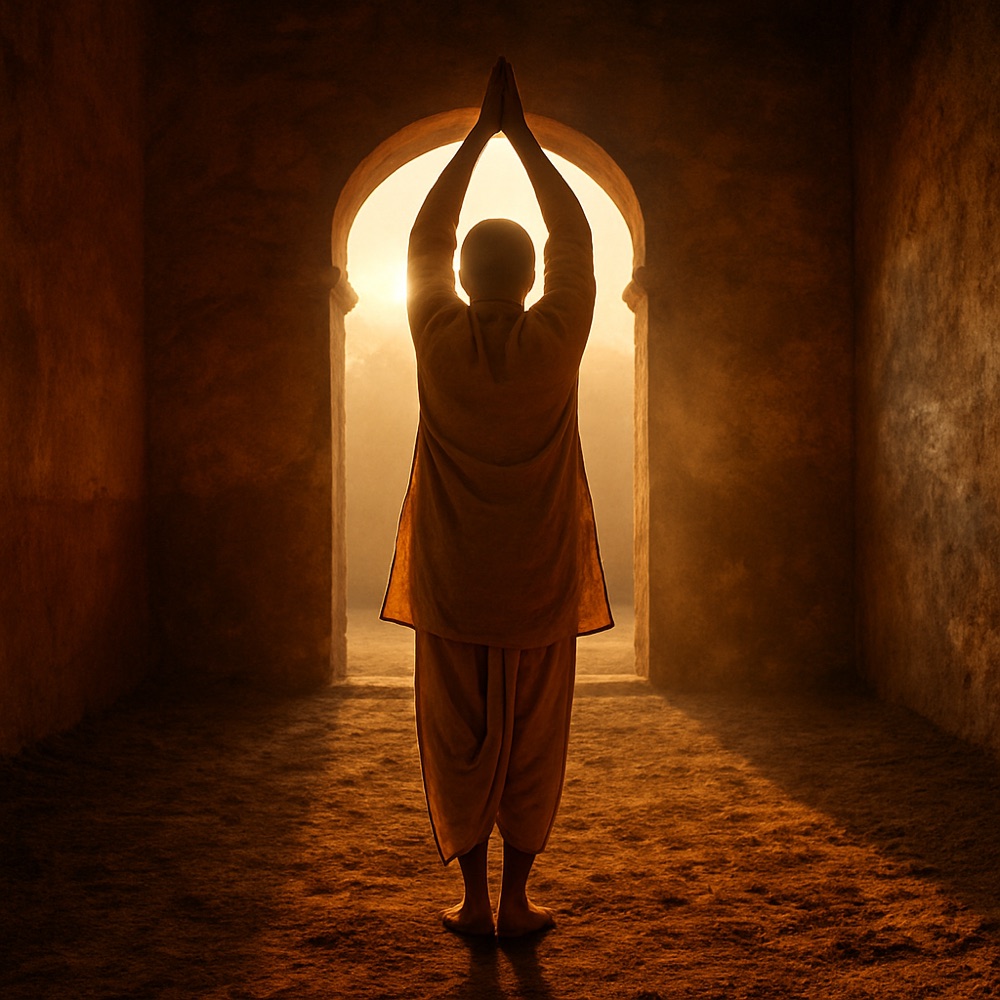
Surya Namaskar सूर्यनमस्कार
The salutation to the sun — the practice most associated with his name, and the one with the most complicated history.
What it does
A continuous cycle moving the spine through forward folds and backbends while the shoulders, hips and legs take turns bearing weight, breath tied to each movement. It warms the whole body, needs no equipment and no more floor than your own height. As a single daily practice covering mobility, light strength and breath together, very little else competes with it.
- Learn the sequence slowly, one round at a time, before adding pace.
- Breathe out folding forward, in opening up. If the breath does not fit the movement, the movement is too fast.
- Start at 4–6 rounds. Add a round every few days, not every day.
- 12 rounds is a solid daily practice for most people; 24 is a serious one.
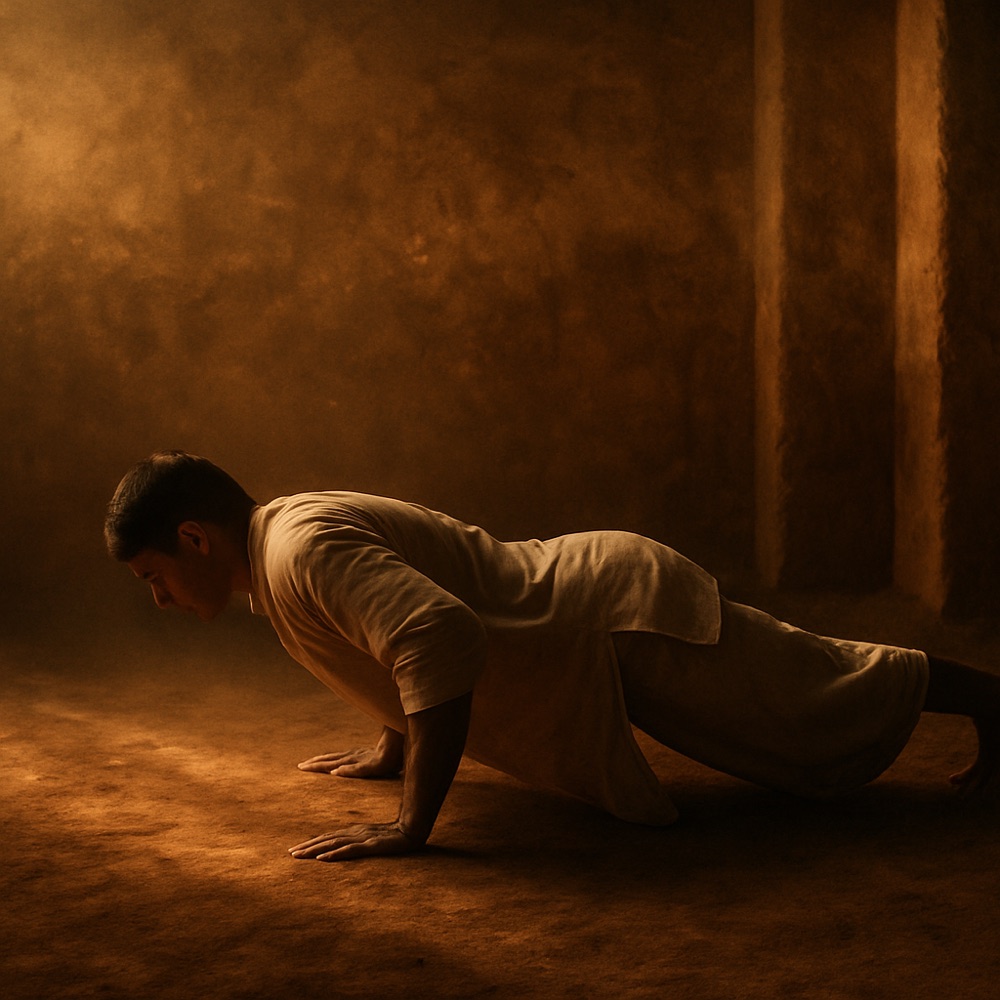
Dand दंड
The Hindu push-up — the akhada's upper-body staple, and not really a push-up at all.
What it is
From a downward-dog position with hips high, you sweep the chest down and through close to the floor and rise into a cobra with the arms straight and the hips low, then push the hips back up and return. Where a Western push-up is a straight line moving up and down, a dand is an arc: it trains the shoulders through a much larger range and adds a spinal wave the flat version has no equivalent for.
- Learn the shape without the dip first — move between downward dog and cobra with the arms straight, ten times.
- Add the sweep once that is smooth. Chest passes low, elbows stay close, no collapsing onto the floor.
- Sets of 5–10. The traditional pairing is two baithaks for every dand — 25 dands to 50 baithaks.
- Progress by adding rounds, not by speeding up.
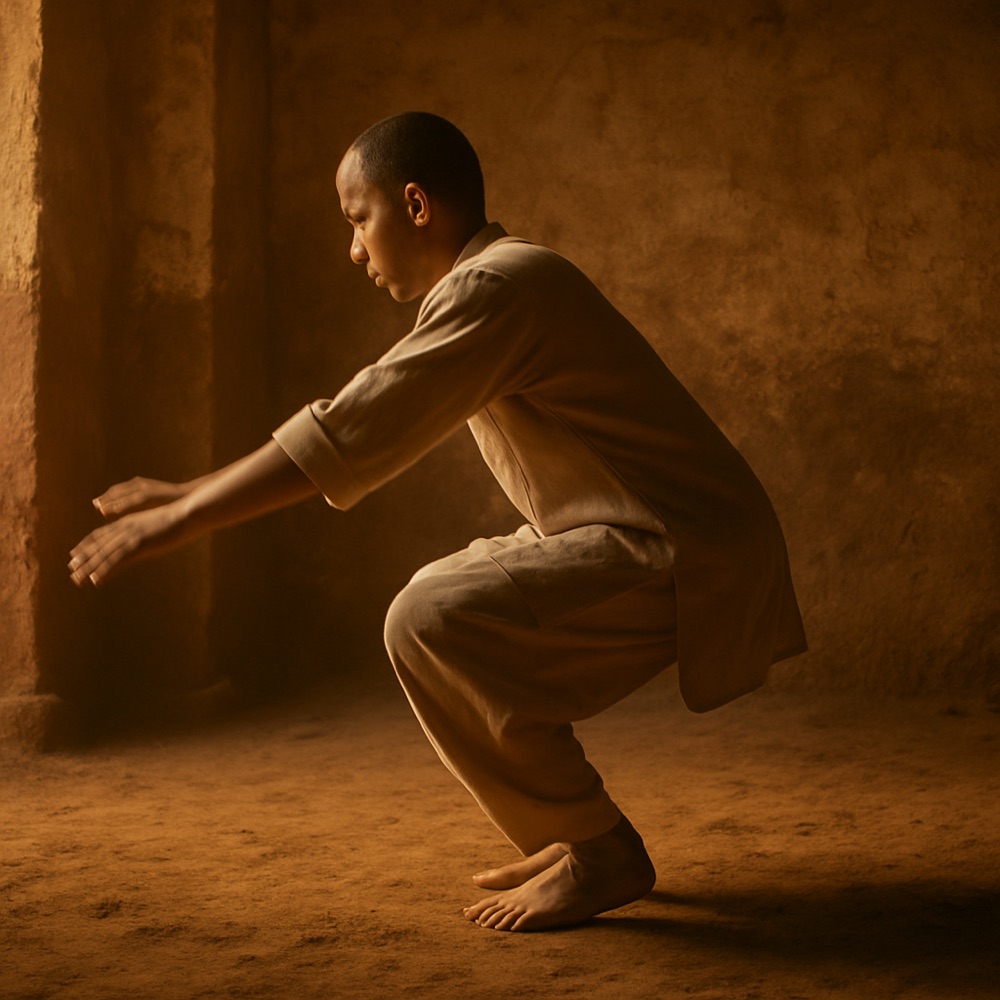
Baithak बैठक
The Hindu squat — the conditioning engine of the whole tradition.
What it is
A fast, rhythmic squat: heels lift, knees travel forward over the toes, arms swing to counterbalance, and you come straight back up without pausing. It is closer to a locomotive drill than a strength lift — done in the hundreds it becomes a conditioning tool that leaves most cardio machines looking dull, and it builds real tolerance in the knees and ankles through a deep range.
- Start with sets of 20–25, resting as needed, three or four sets.
- Keep the rhythm steady and the breath moving — one breath per repetition to start.
- Build to 100 in a session before chasing bigger numbers.
- Pair with dands at two to one, as the akhadas did.
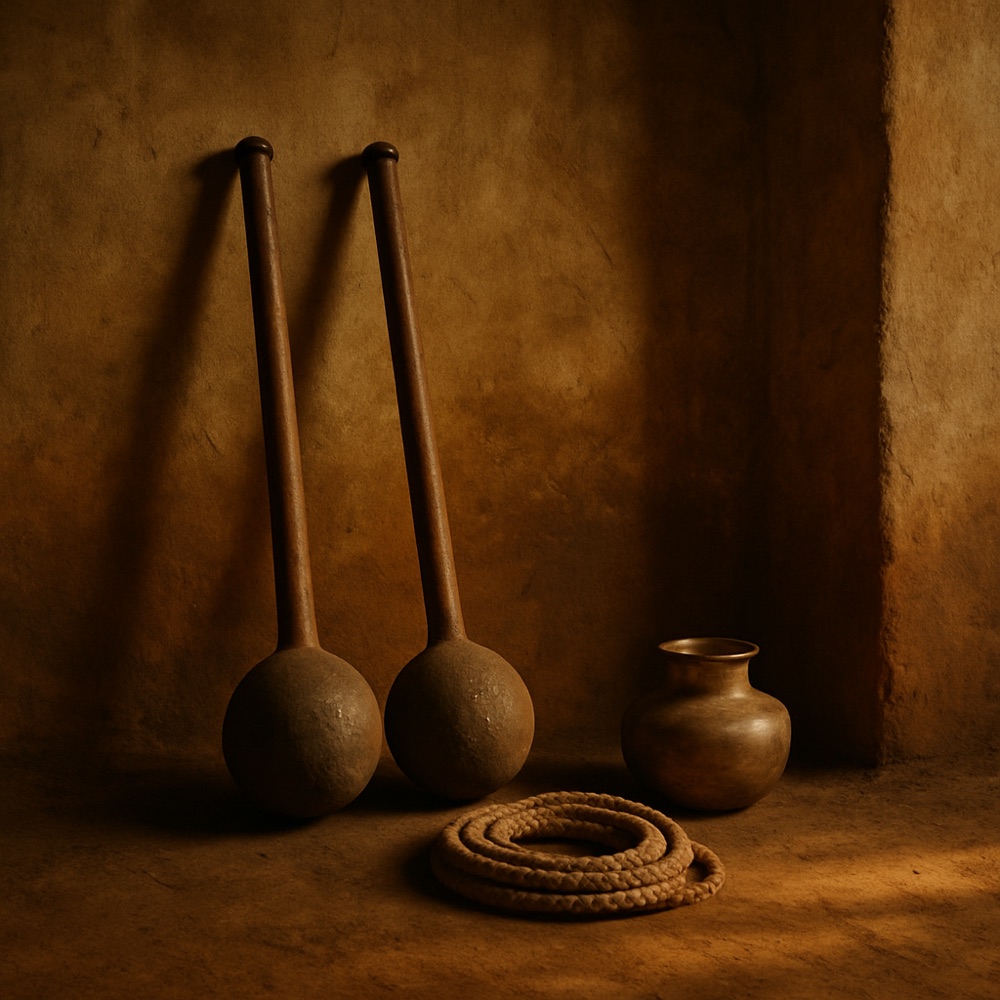
Gada गदा
The mace — Hanuman's own weapon, and the most distinctive implement in the akhada.
What it is
A heavy head on a long handle, swung behind the back and over the shoulder in an arc. Because the weight sits far from the hands, a modest mace feels enormous — the leverage, not the mass, is the training effect. It builds the shoulders, upper back and grip in rotation and overhead, which is precisely the range most modern training neglects, and it teaches the trunk to resist twisting.
- Start far lighter than your ego suggests — 5–7 kg is plenty, and a beginner mace may be lighter still.
- Learn the 10-to-2 swing: the mace falls behind the shoulder, you catch and return it. Small arcs first.
- Sets of 10 each side. Stop the set the moment the path gets ragged.
- Add reps before weight; a heavier mace magnifies every fault.
It was never a standalone exercise
Worth being clear about, because the gada is the piece that travels best on the internet and so gets lifted out on its own. In the akhada it sat inside a whole ecosystem: dands and baithaks in the hundreds, wrestling on prepared earth, oil massage afterwards, and a deliberate diet of milk, ghee, almonds and chana to carry the volume. Mace swings were one component of a comprehensive kushti training system — not a workout, and not a substitute for one.
The practical consequence: if you take the gada without the squatting, the pushing and the recovery around it, you have taken the ornament and left the structure. Build the dand and baithak habit first; add the mace to a body that is already conditioned.
The akhada was a sacred space, not a gym
The dimension that gets stripped out entirely when these exercises are repackaged as fitness. Training traditionally opened by invoking Hanuman — the patron of the akhada and the reason so many of these grounds sit inside his temples. The earth of the pit is prepared, tended and treated as consecrated rather than as flooring; you enter it barefoot and with some deference.
Whether or not you share the devotion, the disciplinary effect is real and worth borrowing: a practice you begin deliberately, in a place you keep with care, is a practice you are far more likely to still be doing in a year. This is the same argument the tradition makes about strength itself — that it is owed rather than optional — applied to the space you train in.
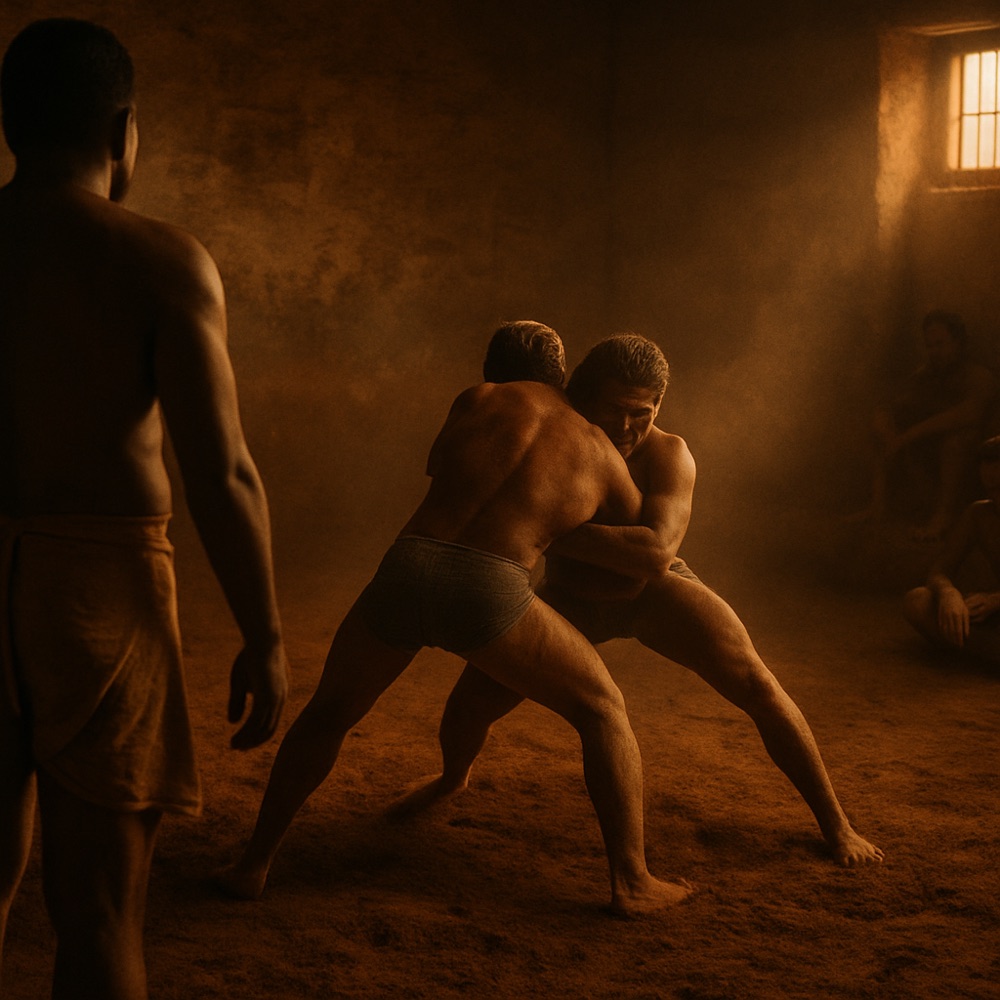
Kushti and endurance कुस्ती
The point all the drilling served.
What the akhada actually did
The conditioning existed for wrestling. Training took place on prepared earth, and the day included preparing the pit itself — digging and turning the soil — alongside running, rope climbing, carrying, and the long grinding sets of dands and baithaks. Diet was plain and enormous: milk, ghee, almonds, chana. The whole arrangement was residential and communal; you trained where you lived, with the people you would wrestle.
- Do something that makes you carry, drag or climb — the drills were never the whole of it.
- Walk and run. Endurance underwrote everything else.
- Train with other people if you possibly can. That was the point of the courtyard.
- If you want the real thing, kushti akhadas still operate — and grappling with a coach beats any solo interpretation.
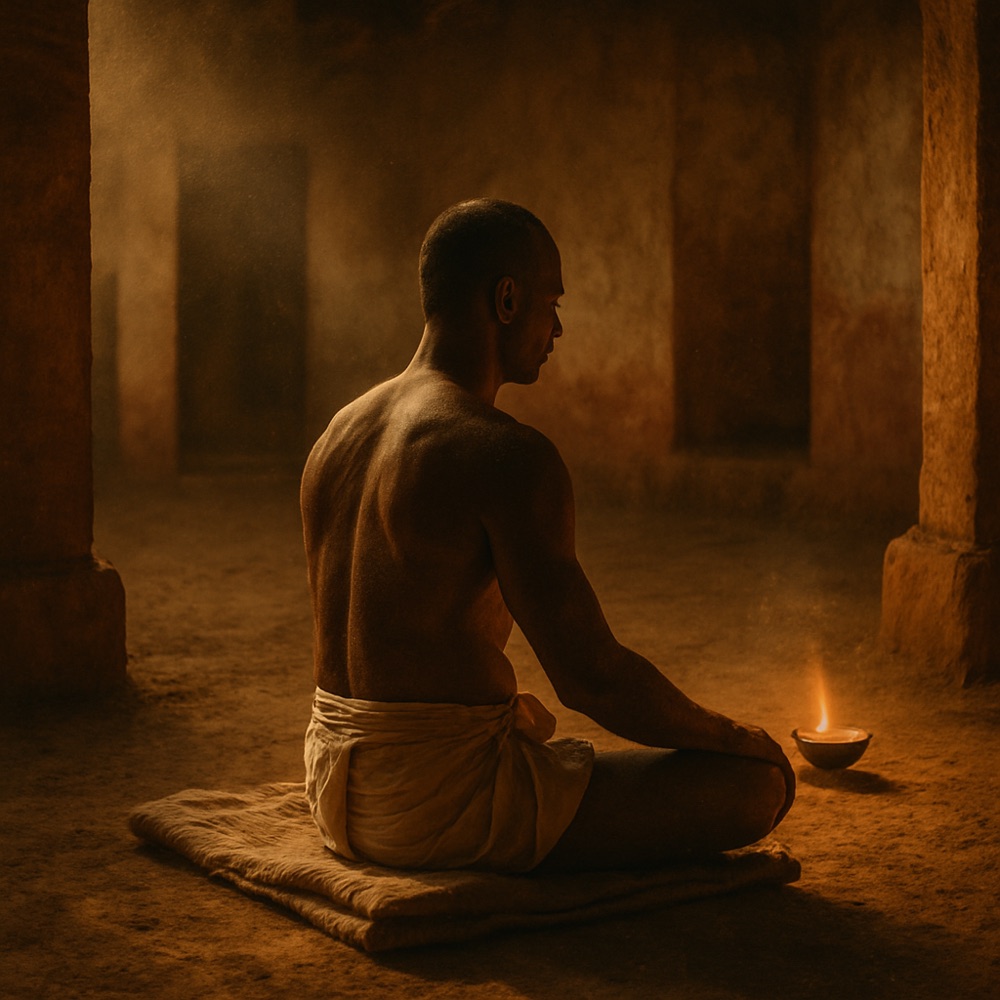
Breath, chanting and sitting प्राणायाम · नामस्मरण
The half that makes it a discipline rather than a workout.
The mental training
Ramdas's own instrument here was recitation. The Manache Shlok — verses addressed directly to one's own mind — are still learned by heart in Maharashtra, and the practice is exactly that: say them daily until they are yours, then let them argue with you. His Dasbodh is the longer work, dictated over years, on how to live and act in the world.
Alongside it: steady breathing, a period of sitting, and namasmarana — repetition of the name — as something done while walking or working rather than only on a cushion.
- Five to ten minutes of slow breathing after training, when the body is already settling. Longer exhale than inhale.
- Learn a few verses by heart rather than reading many. Recitation from memory is the practice; reading is preparation for it.
- Sit for ten minutes. Fixed time of day beats a long session whenever you feel like it.
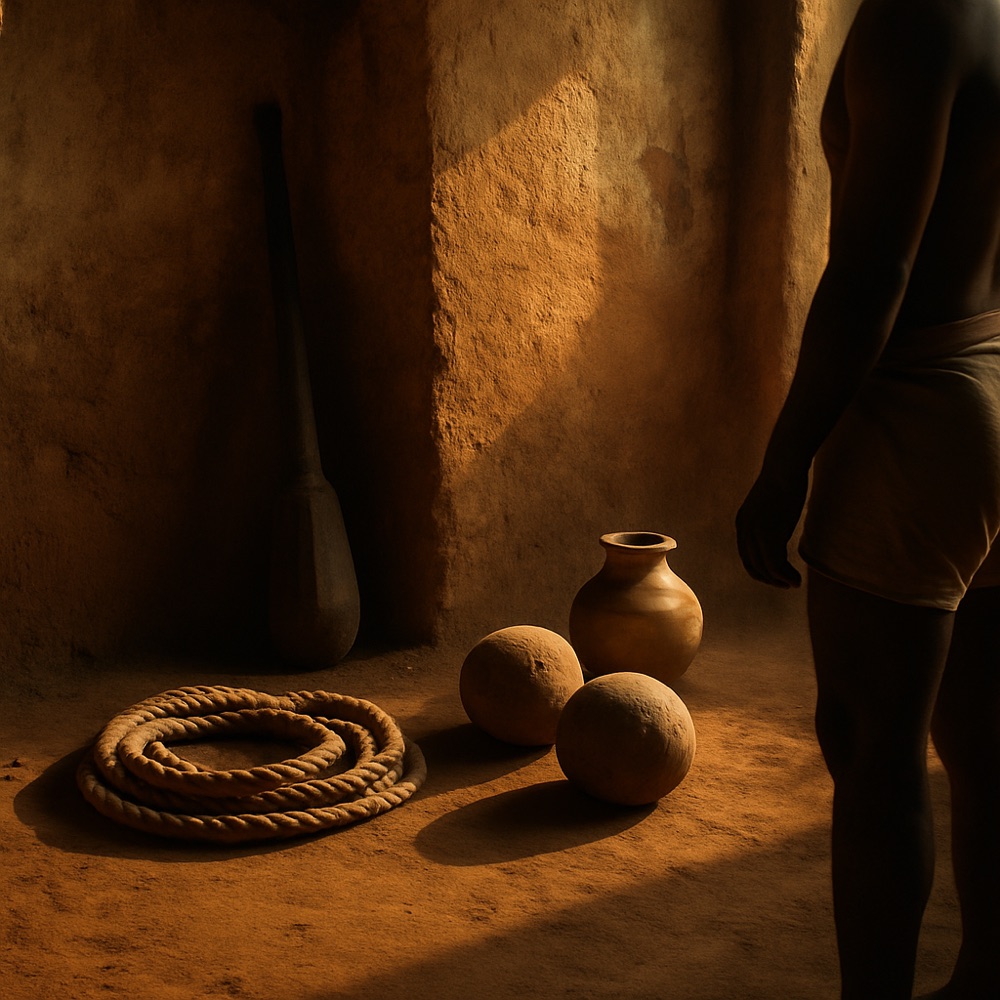
A week to start on
Deliberately small. The tradition's advantage was daily repetition over years, and nothing here should leave you unable to repeat it tomorrow.
| Day | Practice |
|---|---|
| Mon | 6 Surya Namaskar · 3 × 10 dand · 3 × 25 baithak · 5 min breathing |
| Tue | Walk or run 30 min · 10 min sitting and recitation |
| Wed | 6 Surya Namaskar · gada technique, light, 4 × 10 each side |
| Thu | Walk · 10 min sitting |
| Fri | 8 Surya Namaskar · 3 × 10 dand · 4 × 25 baithak · 5 min breathing |
| Sat | Something carried, dragged or climbed · outdoors |
| Sun | Rest. Recitation only. |
History and tradition, kept apart
Ramdas attracts a lot of affectionate attribution. None of it makes the practices less worth doing, but it is worth knowing which is which.
The modern Surya Namaskar is a twentieth-century sequence
Indian tradition links the sun salutation to Ramdas, and some form of sun veneration with movement is genuinely old. But the specific twelve-position sequence practised today was structured in the 1920s by Bhawanrao Shriniwasrao Pant Pratinidhi, the Raja of Aundh, who popularised it and had it taught in schools. What you practise is his arrangement, whatever its ancestry.
Whether he was Shivaji's guru is disputed
The story of Ramdas as spiritual guide to Chhatrapati Shivaji Maharaj is the best-known thing about him, and historians treat it with caution. Ramdas's own works — the Dasbodh and the Manache Shlok — do not mention Shivaji at all, despite discussing righteous war at length. Shivaji's own administrative records and letters do not name Ramdas as his guru; where early influences are credited, they go to his mother Jijabai and to Dadoji Kondadev. The guru narrative appears in the bakhars, Marathi chronicles composed in the eighteenth and nineteenth centuries, well after both men were dead.
This does not diminish either figure. It does mean the familiar framing — that the saint supplied the philosophy behind the kingdom — is a later reading rather than a documented fact.
The numbers are devotional
1,200 Surya Namaskars a day for Ramdas; 3,000 dands and 5,000 baithaks for the wrestler Gama. The first is a traditional account of a saint's discipline. The second is a report about a full-time professional at the height of a fifty-year career. Both are there to convey seriousness, and neither is a programme.